Normandale Community College’s Department of Theatre recently finished the first weekend of performing Come From Away on October 23-24. There will be three more performances on Thursday, October 29 at 7:30 p.m., Friday, October 30 at 7:30 p.m. and Saturday, October 31 at 2 p.m.
Prior to the opening weekend, Normandale Theatre Instructor Anne Byrd talked about a variety of aspects of directing Come From Away at Normandale.
Talk about the extra meaning of doing the show during the 25th anniversary of 9/11.
Anne Byrd: “It is a big question, because it is notable that it is the 25th anniversary of 9/11. To be doing the show at this moment in time is particularly poignant. I think the beautiful thing about the show is that it honors those people who did such a remarkable thing for the stranded passengers, and it showcases them. It is a testament to their goodness and their kindness in that moment, which is absolutely important.
 They are so worthy of all of the praise and accolades. Also, I think the show serves as a wonderful reminder that we should consider how we show up for other people at any moment in time. We should interrogate the question of what we might have done if we were in that situation, but also today how would we react if a stranger showed up on our doorstep needing safety, needing comfort, needing grace and kindness. It is a celebration of those people in that moment in time, but I think it also asks us to participate in examining how we show up for other people when they are in really traumatic and challenging times.”
What are you excited about with this production and the process of putting it together?
AB: “I love that everybody is doing Come From Away because it's such a beautiful story and I think it speaks across communities. I think that it's the kind of show that a lot of people can do. It is really about the story and about the characters. I'm sure we will see versions of it that are simple and paired down and more minimal, and I'm sure they will be deeply moving because the story itself is so beautiful.
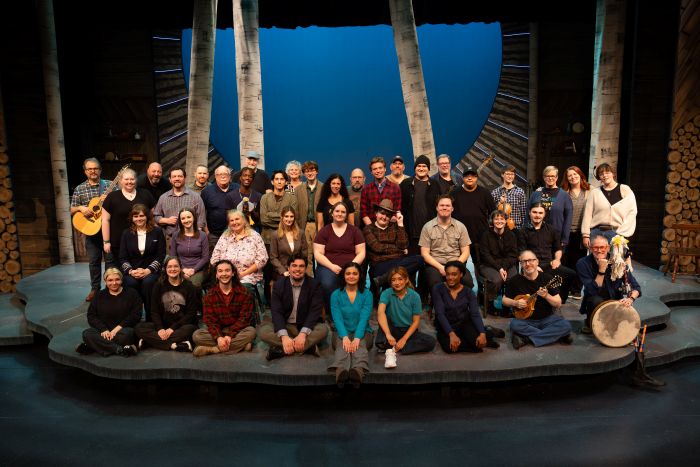
Our production is a little more expansive. We are fortunate to live in an area where theater is part of our community. We have a very strong theatrical community in the Twin Cities, so we are able to work with our guest artists that give our students an opportunity to have connections within this theater community that exists here. We're very pleased that they're able to interact with theater artists of the highest caliber. We have guest designers, a musical director, and a choreographer that the students are working with that are wonderful collaborators, because they provide that connection and bridge to the profession. They also understand that we are a teaching environment above all else. So they guide and push our students. We feel like our students are having this opportunity to really grow as theater artists both on stage and behind the scenes.
The show itself, in the way that we've decided to do it, is a bit of a heavy lift. It's a big show. There's a lot going on, but our primary goal is that our students expand, grow, develop their technique and their skillset. The thing that we're always most proud of with any production is that we're giving our students a chance to take the theory that they're learning in the classroom and put it into practice. The productions are the lab for their learning that moves it from theory to practice, and it's an essential step for them. Most of all, what we're excited about is watching the students be able to grow through a production process.”
What are some details that you can share that you all are doing with this production?
AB: “The design is pretty expansive. It's quite a beautiful design. The show can be done very simply because the actors create the various environments of the play.
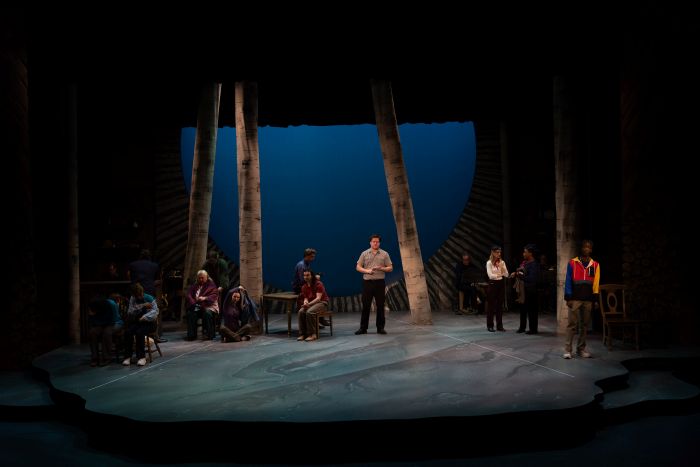
It's essentially a long one act. It is performed without an intermission, and it has 41 scenes. You're going so many different places. You're in the school, you're in the town hall and you're outside on the street. So there's this approach that is also evident in the Broadway version where the actors themselves use furniture to create different environments so that the audience can follow along as we move through this town and into other towns.
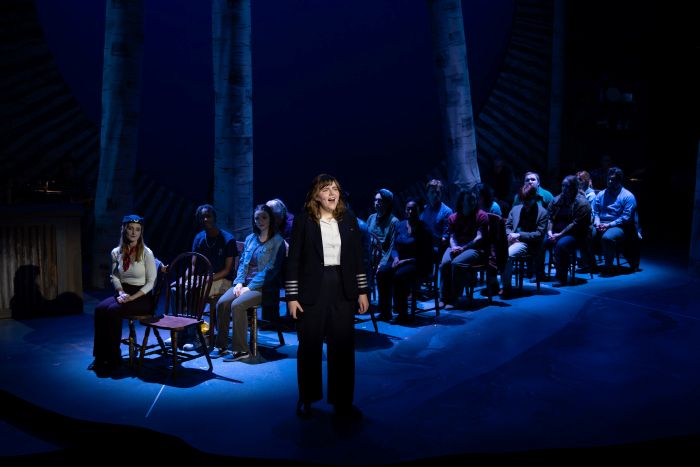 Our design tries to create a universal environment that feels like the setting of Gander, which is so important. It's an island, it's a very natural place and it's a very organic place. I think the set beautifully captures this feeling of the natural environment, the warmth of that environment, and the warmth of the people.
If you're going all different places, the lighting design is really important. We have a wonderful lighting designer that helps us move from place to place, but also the show uses direct narration with the audience a lot. So the lighting design especially helps to create focus. It helps the audience know who's got the through line of the moment in terms of telling the story.
The original cast was 12 people. It was designed for 12 people to play many characters in the show. It was originally written for 12 actors to have 12 different tracks where they played multiple characters. We have expanded the cast to 16, so our cast is a little bigger. We're also doing all the dialects across the world. So we have a dialect specialist. I would probably say that we're doing a little more choreography than maybe some other companies are going to do. Those are some of the ways that we've sort of expanded the play in our version of it.”
Talk about the rest of the 2026-27 season, and how this production sets the stage for it.
AB: “It’s always our goal when we decide a season to try to have some breadth in that season so that the students encounter different styles, genres and messages. I feel like we have a pretty wide-ranging collection of shows. We're starting with what will be a big musical that is going to ask performers to use all their skills, physical, acting, intellectual skills, and try to hone those.
The next play is interesting because it is contemporary one, and it's important that our students are aware of contemporary dramatic literature. One of the things that's most interesting is that it’s a new kind of twist adaptation on what I think you would have people argue is one of the most important pieces of dramatic literature from the past. That's a fascinating academic thing to study. We're studying it in class. How you adapt something from the past to be relevant today. We're doing some special things with that.
Then we have a really small, intimate, kind of vulnerable musical that will ask that group of people to really dig in to the things that an actor does to bring their whole self to a role, to explore their own empathy and vulnerabilities so that they can create characters that are authentic and truthful.
We’re ending the season with a Shakespeare piece, which is its own challenge, given the heightened language. It’s a great challenge for our students. They have to use that muscular language, and it helps them develop vocal technique that ends up not just helping them in a Shakespeare play, but in all of their work, because they are storytellers and their voice is one of their most important instruments in telling stories.
We love that this group of performances has a wide range of opportunities for our students. We look forward to tackling it all.”
Talk about the experience of both yourself and your husband (Normandale Theatre Instructor Sean Byrd, who directed Come From Away at the Phipps Center for Arts in Hudson, Wis, in mid-September) directing Come From Away for different groups around a similar timeframe.
AB: “It is a fascinating thing and it's never happened before. We have done the same show before in different constructs. I've been in something that he's directed or vice versa. But we have never been directing the same show at essentially the same time, which we did.
 There was overlap in the process. For us, and this may be different than other people, we sort of kept our separate processes because as a director you are looking to interpret the script in a way that makes sense to you, how you've analyzed it and with the specific group of people with whom you are working.
Doing it in an educational institution with students on stage and off that are at a certain point in their training is a very different experience than doing it in a professional setting. There were occasionally times where one of us would say to the other, “How are you dealing with that?" or “How are you doing that?”. However, for the most part, we stayed in our own lanes.
I did see his show. It opened on September 11th on the actual 25th anniversary, but I waited until the last possible moment in the run to see it because I didn't want to have it color anything that we were doing here.
I love the show, and I was very happy to get to see somebody else do it. I don't know that it's a show that I will ever get tired of, even though I've worked on it now for these past couple of months. I think I will see it whenever I can because it's such a beautiful show.”
 top